
𝐎𝐩-𝐄𝐝: 𝐏𝐫𝐞𝐬𝐢𝐝𝐞𝐧𝐭 𝐀𝐝𝐚𝐦𝐚 𝐁𝐚𝐫𝐫𝐨𝐰 𝐂𝐚𝐧 𝐑𝐮𝐧 𝐟𝐨𝐫 𝐑𝐞𝐞𝐥𝐞𝐜𝐭𝐢𝐨𝐧 𝐎𝐧𝐞 𝐌𝐢𝐥𝐥𝐢𝐨𝐧 𝐓𝐢𝐦𝐞𝐬 𝐈𝐟 𝐇𝐞 𝐖𝐚𝐧𝐭𝐬
Updated: Jul 15
In The Gambia, outrage is dead. Accountability is buried. Who benefits while workers starve?
President Adama Barrow can run for reelection one million times if he wants. The constitution today places no hard limit on his ambition. But the Gambian political environment teaches a different lesson. In Kerewan, a worker’s monthly wage dies by day ten. In Fajara, what many describe as the “mother of all residential estates” rises from the ground, built by a man who once lived in a small confinement at Yaaram Bamba Yundum. If legality allows infinite terms, reality shows infinite entitlement. This is not development. This is dynasty wearing a ballot paper.
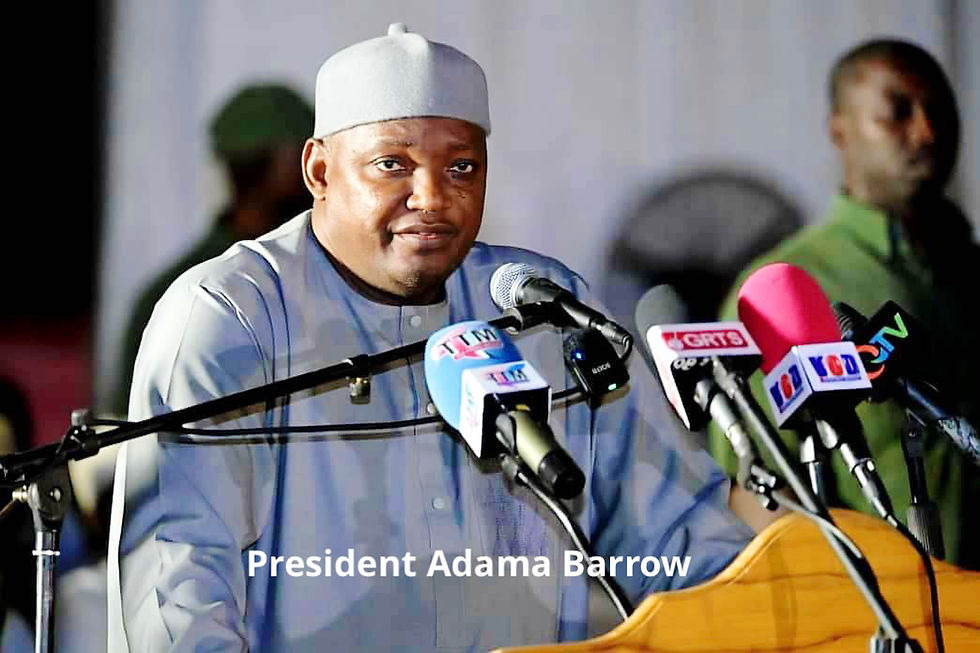
2016 was supposed to be The Gambia’s reset. Twenty-two years of autocracy ended. Hope walked the streets from Banjul to Basse. The opportunity to change everything presented itself. Nine years later, the outcome is atrocious and a disappointment of biblical proportions. Roads are not the issue. Schools are not the issue. Hospitals are not the issue. The issue is that “development” became personal construction. The state became a private contractor for those who captured it. We asked for a Republic. We got a real estate portfolio.
Look at Mankamang Kunda. A hamlet. A settlement most Gambians could not find on a map before 2016. In less than a decade of presidential power, it has been transformed into palace structures and compounds that many now call one of a kind in the West Africa region. Ask the market woman in Brikama: whose budget built it? Ask the teacher in Janjanbureh: whose salary paved those roads? When a village transforms faster than a nation, you are not watching policy. You are watching privilege.
In 2021, during presidential filings with the IEC, President Barrow was publicly reported to have declared assets exceeding D200 million. Put that figure next to 1.52% of GDP spent on health. Put it next to maternal mortality at 289 per 100,000. Put it next to under-5 mortality at 56 per 1,000. The mathematics of betrayal writes itself. When money lives in declarations and dies in clinics, the worker knows exactly where he stands: outside, looking in, holding a hospital bill he cannot pay.
Then there is Fajara. The same President Barrow who once lived in a small confinement at Yaaram Bamba Yundum, West Coast Region, is now associated with what citizens call the mother of all residential estates, one for the ages in Africa. Less than a decade. No known private sector empire before State House. The question is simple and the people ask it daily: what changed? In a country where 48.6% live below the poverty line, luxury does not happen by accident. It happens by access.
After Yahya Jammeh fled, the state confiscated his assets. What happened next is the question that hangs over Banjul. Many Gambians allege that those assets are being repurchased through cronyism, chicanery, and skullduggery. The faces change. The system does not. When confiscation becomes circulation among friends, justice is not served. It is auctioned. And the poor taxpayer, who owns that debt, is never invited to bid.
Gambia, what’s the outrage? Where is accountability? Where is justice? Nine in ten Gambians have no medical aid. Eight in ten fear they cannot afford care. Adult literacy is 58.67%. Only 3.94% of WASSCE students pass with 5 credits including English and Math. Yet there is silence. Is it fear? Is it fatigue? Or is it complicity? A nation that stops asking questions has already answered them. The answer is: we accept this.
The opposition has failed to be accountable and failed to keep President Barrow and his administration accountable. That is the verdict. They do not function as watchdogs. They function as understudies. As I wrote on May Day: in advanced societies, people enter politics after successful careers to bring wealth to service. In our society, citizens enter politics to fulfill dreams that eluded them in a lifetime. They arrive hungry. They leave landlords. The worker sees it. The worker remembers.
This is not about development or changing anything. The proof is in the first ten days of every month. The gospel truth is this: the majority of workers consume their entire monthly wage in the first 10 days. Then the borrowing begins. Endlessly. Hopelessly. On the eve of Labor Day, April 30, the government announced a substantial fuel hike. You don’t hike fuel on Labor Day eve unless you have declared war on labor itself. The fare hikes hit the market woman, the nurse, the student. The only people who do not pay are the officials with unlimited fuel vouchers.
Healthcare is a crime scene. Education is a betrayal. Living conditions of the poor, underprivileged, and oppressed are an indictment. 37% of youth are NEET. Not in Education, Employment, or Training. Youth labor force participation is 35%. That means 65% of young Gambians are idle. Idle hands. Idle dreams. Idle fuel for the next boat to Europe. Meanwhile, politicians who could barely afford daily meals five years ago now build mansions and drive multi-million dalasi vehicles. All on a government salary. All to the exclusive detriment of the poor taxpayer.
This is the system, not just the man. From Independence in 1965 to May Day 2026, the Gambian question remains unanswered. What is this nation for? Who does it serve? We still import toothpicks and export our youth. We still borrow to pay salaries and borrow again to pay the debt on salaries. The collapse of Republican institutions is no longer conjecture. When the Auditor General is sacked for doing his job, when oversight is punished, when accountability becomes treason, the Republic is not struggling. The Republic is gone.
So here is the verdict, unapologetic and spicy: The Gambian worker is not lazy. He is looted. The Gambian family is not poor. It is robbed. The unemployed are not hopeless. They are abandoned. Until politics stops being a poverty escape plan and starts being a service contract, every election will be a funeral for hope. We demand bread. We demand books. We demand hospitals. We demand light. If you cannot deliver, resign.
Barrow can run for office a million times and build golden streets everywhere. But the reality is this: there must be accountability. This sudden wealth must be explained. All the back door contracts must come to light. Cronyism. Kleptocracy. Corruption. This is what this election is about and nothing else. The opposition, given their incompetence, vapidity and hollow campaigns, can’t make Barrow accountable because they are not up to the task. You cannot fight a palace with a press release.
History does not ask how many times a man ran. History asks what he built when he had the chance. Did he build clinics or compounds? Did he build schools or silos for himself? Did he build a nation or a name? Nine years after Jammeh, The Gambia is still waiting for an answer. The concrete is pouring in Fajara. The debt is pouring on the people. One of those will outlast the other. And the people know which one it is. You cannot pave over hunger with marble tiles.
I did not learn these lessons in a classroom. I learned them in the field. I helped contain the ravages of war in war-torn countries across Africa. I helped save lives in the sectarian violence of Central African Republic. I stood in the breach during the election conflicts of Côte d’Ivoire, Guinea, Mali, and Sierra Leone. I worked through the collapse in Libya. I saw the aftermath in Angola and the tensions in Kenya, to name a few. I know what it looks like when accountability dies. It looks like empty clinics. It looks like youth on boats. It looks like leaders who build palaces while the Republic burns. The Gambia is not there yet. But I have seen the road. And I know where it leads if we do not turn.
Now let me speak as Musa Basad, son of Kerewan, from a father who is one of the most honest, decent, devout Muslims I have ever known, Basad of Almamy Nianni Barrajally. My father taught me two things I never forgot. First: a man’s worth is not in his compound, but in his word. Not in his fleet, but in his fairness. Second: remain truthful always, and never bow to sycophancy or flattery for personal gain. I have gone from village life to the corridors of power in Washington, D.C., and met authorities one can only imagine meeting in the most advanced economies. I have seen Sahel dust and Senate halls. I have carried boxes with Filipino seamen and signed letters for Ghanaian nurses. But I have never forgotten the smell of rain on Kerewan ground.
The measure of a man is not the height of his title, but the depth of his humility. Dignity is not a budget line. It is the budget. So I say this to every worker in Bintou’s Point and beyond: your suffering is not invisible. Your wage is not a joke. Your vote is not a favor. It is a contract. Break it, and we break our silence. I am not your savior. I am your witness. And as long as I breathe, I will not be silent while workers suffer and politicians feast. That is my oath. That is my labor. That is The Gambia we must still build, for our fathers, and for our children.

Musa Bassadi Jawara
Economist & Author
Bintou’s Point, Kerewan
Monday, July 13, 2026
Editors note:The opinions expressed here belong to the author and may not reflect the perspectives of Gunjuronline.com.
Have an opinion piece you'd like to publish? Email it to editor@gunjuronline.com
Do you have a story or an opinion piece you’d like to share?
Get in touch by contacting us at: editor@gunjuronline.com
Share your views on this article in the comments below.


Comments